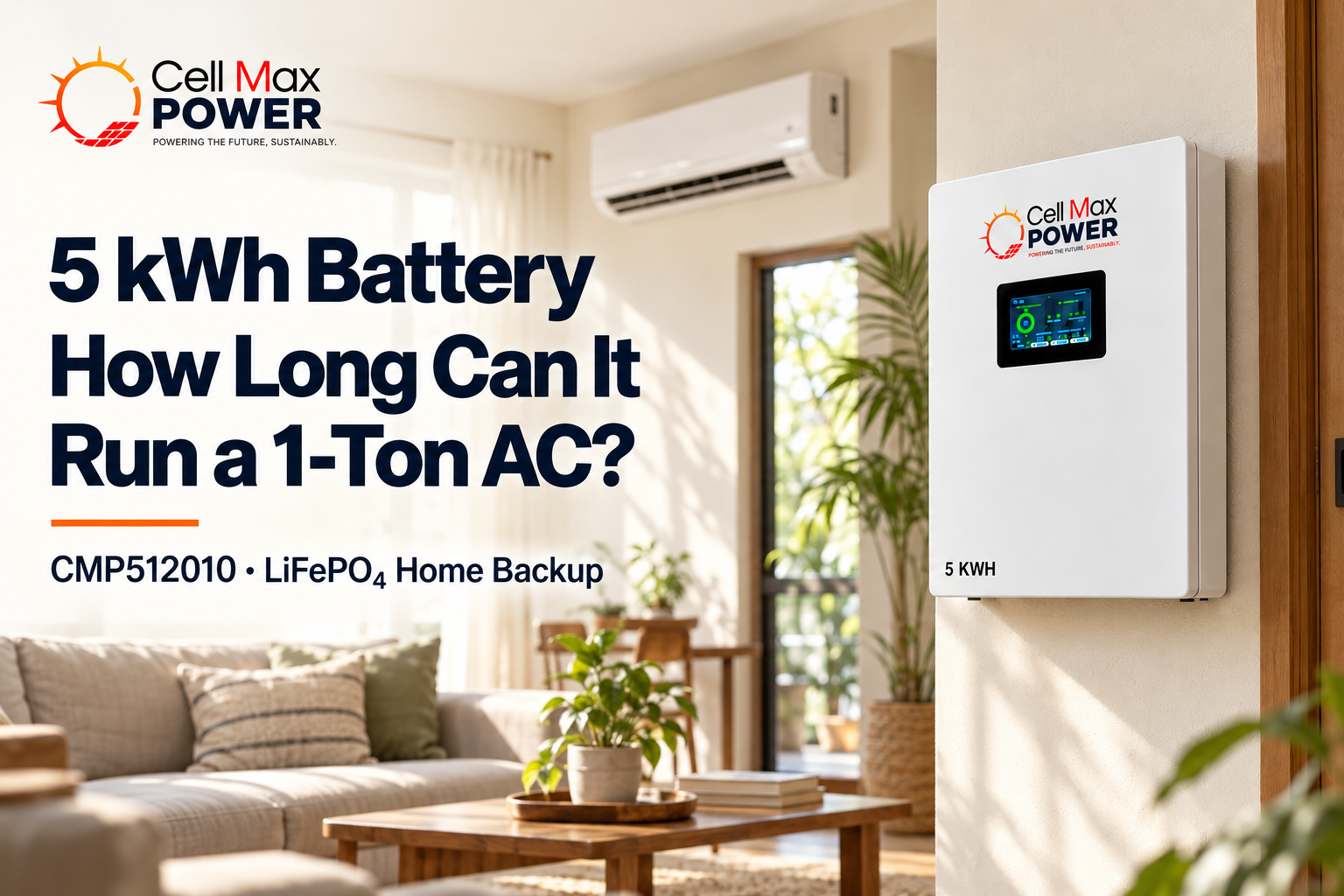
When the electricity goes out, keeping your home comfortable becomes a priority. Lights, internet, refrigeration and cooling all matter, especially during hot weather. That raises a practical question: can a 5 kWh lithium battery run a 1-ton inverter AC alongside everyday appliances?
It can form part of a suitable backup system, but runtime depends on the combined load, available battery energy and inverter compatibility. Here is an example using the Cell Max Power CMP512010, a 5 kWh LiFePO₄ battery designed for home, business and solar applications.
What Does a 5 kWh Battery Capacity Mean?
A battery’s capacity describes how much electrical energy it stores. A nominal capacity of 5 kWh equals approximately 5,000 watt-hours.
In a simplified calculation, a 500 W load would consume 5,000 Wh over ten hours. Real installations deliver different results because battery discharge settings, inverter losses and operating conditions affect the energy available to appliances.
Also, battery capacity and inverter output are different measurements. The battery stores energy, while the inverter must handle the appliances’ combined running power and any starting surge. Both need to suit your intended load.
An Example Household Load with a 1-Ton AC
To understand 5 kWh lithium battery backup time, start by listing the appliances you want to operate during an outage.
The following example includes one 1-ton inverter AC and several household essentials:
| Appliance | Quantity | Combined Running Load |
|---|---|---|
| Refrigerator | 1 | 150 W |
| Wi-Fi router | 1 | 15 W |
| LED lights | 6 | 60 W |
| Television | 1 | 100 W |
| Phone or laptop charging | 2 | 60 W |
| 1-ton inverter AC | 1 | 1,000 W |
| Total | 1,385 W |
These figures are illustrative assumptions. Check appliance labels or measure actual consumption before choosing a system. The AC is assumed to draw 1,000 W; its actual demand can change considerably during use.
Calculating the Estimated Battery Backup Time
For this example, assume that 90% of the battery’s nominal energy is available to supply the load after the allowances used in the estimate.
Estimated available energy:
5,000 Wh × 90% = 4,500 Wh
Estimated backup time:
4,500 Wh ÷ 1,385 W = approximately 3.2 hours
Under these assumptions, the battery could support the listed appliances for roughly three hours and fifteen minutes.
This is an illustrative calculation, rather than a guaranteed runtime. Your installer should use the actual battery settings, inverter efficiency and measured appliance consumption for a more accurate estimate.
Why Inverter AC Consumption Changes
A 1-ton AC does not necessarily consume the same amount of electricity throughout an outage. An inverter model adjusts compressor operation according to cooling demand.
Room size, outdoor temperature, insulation, thermostat settings and the number of occupants all influence consumption. Cooling a hot room initially may require more power than maintaining an already comfortable temperature.
For battery backup for a 1-ton inverter AC, measured electricity consumption is more useful than cooling capacity alone. Two AC units with the same tonnage can create different backup requirements.
Cell Max Power CMP512010 Features
The Cell Max Power CMP512010 offers the following specifications supplied for this model:
- 5 kWh nominal capacity for stored backup energy.
- LiFePO₄ chemistry for solar and backup applications.
- 48V / 100Ah stated rating.
- Built-in Battery Management System, supporting battery monitoring and protection.
- Digital touch screen for viewing battery information.
- 6000+ charge cycles, subject to operating and test conditions.
- Wall-mounted design for a tidy installation.
- Five-year warranty, subject to applicable terms and fair usage.
Before purchasing, confirm the model’s datasheet, compatible inverter settings and warranty coverage with your supplier.
How to Make Your Battery Backup Last Longer
Managing consumption helps you get more useful backup from your lithium battery for home.
During an outage, prioritise the appliances you actually need. Switch off unused lights and televisions, and avoid adding high-consumption equipment such as electric kettles, irons or heaters to an already loaded system.
For cooling, keep doors and windows closed and maintain your AC according to the manufacturer’s instructions. A suitable temperature setting can also help manage demand.
Ask your installer to configure battery discharge limits correctly. Changing protection settings simply to extend runtime can affect system operation and warranty eligibility.
Choosing a 5 kWh Lithium Battery in Pakistan
When comparing a 5 kWh lithium battery in Pakistan, consider more than the advertised capacity or purchase price. Check inverter compatibility, permitted discharge power, installation requirements, after-sales support and written warranty terms.
A LiFePO₄ solar battery should match your household’s actual needs. If you require longer AC operation, your installer may recommend additional compatible storage or a different load plan.
Contact Cell Max Power to discuss your appliances and find a suitable backup configuration.
Call: 0331 2478441
Website: cellmaxpower.com


Leave a comment