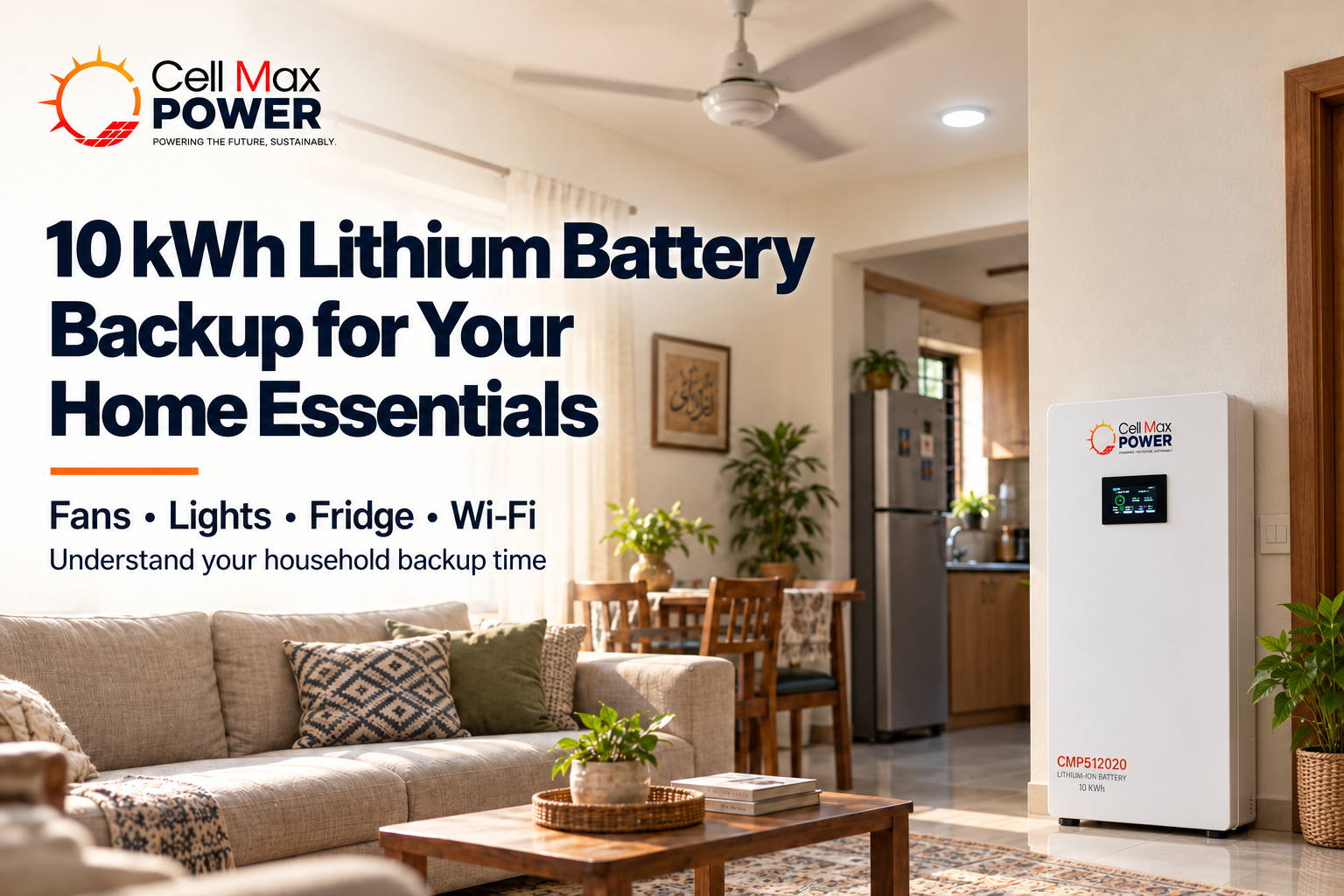
You do not always need to power every appliance during a power cut. For many households, the priority is simple: keep the fans running, switch on essential lights, maintain internet access and keep the refrigerator operating.
A 10 kWh lithium battery for home backup can provide stored energy for these everyday needs. However, its backup time depends on how much electricity your appliances consume and how much battery energy your system makes available.
Below, we calculate 10 kWh lithium battery backup time using a modest household load, without an air conditioner or other heavy appliances.
What Does a 10 kWh Lithium Battery Mean?
A battery rated at 10 kWh stores a nominal 10,000 watt-hours of electrical energy. This describes its energy capacity, rather than the maximum appliance load it can run at one time.
For example, a continuous 1,000 W load would use 10,000 Wh over ten hours in an ideal calculation. Actual backup is lower once battery reserve settings, inverter losses and other operating factors are considered.
The inverter also matters. Its output rating, surge capability and compatibility with the battery must suit the appliances you intend to operate.
A Basic Home Load Without AC
There is no single minimum load that applies to every home. A small apartment and a larger family home will have different requirements.
For this example, we will use one refrigerator, two conventional ceiling fans, four LED lights, a Wi-Fi router and phone charging.
| Appliance | Quantity | Assumed Watts per Appliance | Total Load |
|---|---|---|---|
| Refrigerator | 1 | 150 W | 150 W |
| Ceiling fans | 2 | 70 W | 140 W |
| LED lights | 4 | 10 W | 40 W |
| Wi-Fi router | 1 | 15 W | 15 W |
| Phone chargers | 2 | 10 W | 20 W |
| Total running load | 365 W |
These are example figures. Your actual appliances may consume more or less electricity. Check their labels or measure their consumption before finalising your backup requirements.
Calculating 10 kWh Lithium Battery Backup Time
For a simple planning estimate, assume that 90% of nominal battery energy reaches the appliances after the combined allowances used in this example.
Estimated available energy:
10,000 Wh × 90% = 9,000 Wh
Estimated backup time:
9,000 Wh ÷ 365 W = approximately 24.7 hours
Under these assumptions, a nominal 10 kWh battery could support the example load for approximately 24 hours and 40 minutes.
This calculation assumes that the entire 365 W load runs continuously. It is an illustration, rather than a guaranteed runtime. Actual available energy depends on the battery’s specifications, reserve settings, condition and inverter efficiency.
Why Your Actual Backup Time Will Differ
Household electricity use changes throughout the day. Phone chargers do not necessarily operate continuously, lights may be switched off during daylight, and a refrigerator’s compressor cycles according to cooling demand.
These changes can reduce average consumption. However, hot weather, frequent refrigerator door opening or additional appliances can increase it.
Battery temperature, ageing and system settings also affect performance. A useful solar battery backup time estimate should therefore use measured average consumption and the system’s actual usable energy.
Backup Estimates at Different Home Loads
Using the same illustrative 9,000 Wh of available energy gives the following results:
| Continuous Household Load | Estimated Backup |
|---|---|
| 250 W | 36 hours |
| 365 W | 24.7 hours |
| 500 W | 18 hours |
| 750 W | 12 hours |
| 1,000 W | 9 hours |
These estimates exclude any solar generation or grid charging during the backup period. They also assume that the load stays constant.
The table shows why appliance selection matters. Adding equipment reduces runtime even when the battery capacity stays the same.
How to Extend Backup for Essential Appliances
The most practical approach is to decide which appliances genuinely need backup power.
Keep essential lights and fans on, but switch off equipment in empty rooms. Avoid using electric irons, kettles, water heaters and other high-consumption appliances during an outage unless your system has been designed for them.
Check your fan consumption too. Different models can draw substantially different amounts of power, so use the actual wattage when calculating your load.
Ask your installer to set an appropriate battery reserve. Do not change protective settings simply to obtain a longer advertised runtime.
Choosing a Lithium Battery for Home Backup
When comparing a 10 kWh lithium battery in Pakistan, look beyond the capacity printed in the product title.
Confirm the exact nominal energy, usable capacity, permitted discharge power, inverter compatibility and installation requirements. A battery sold within the “10 kWh” category may have a different exact nameplate capacity, so calculations should use its datasheet value.
For a LiFePO₄ battery for home, also review the written warranty, operating conditions and after-sales support. Cycle-life claims should be considered alongside their stated test conditions.
Plan Your Home Backup with Cell Max Power
A carefully managed basic household load can make stored battery energy last much longer than a system running heavy appliances.
Start with an appliance list, confirm actual consumption and choose a compatible battery and inverter combination. Cell Max Power can help you discuss a configuration based on your household’s essential needs.
Call: 0331 2478441
Website: cellmaxpower.com



Leave a comment